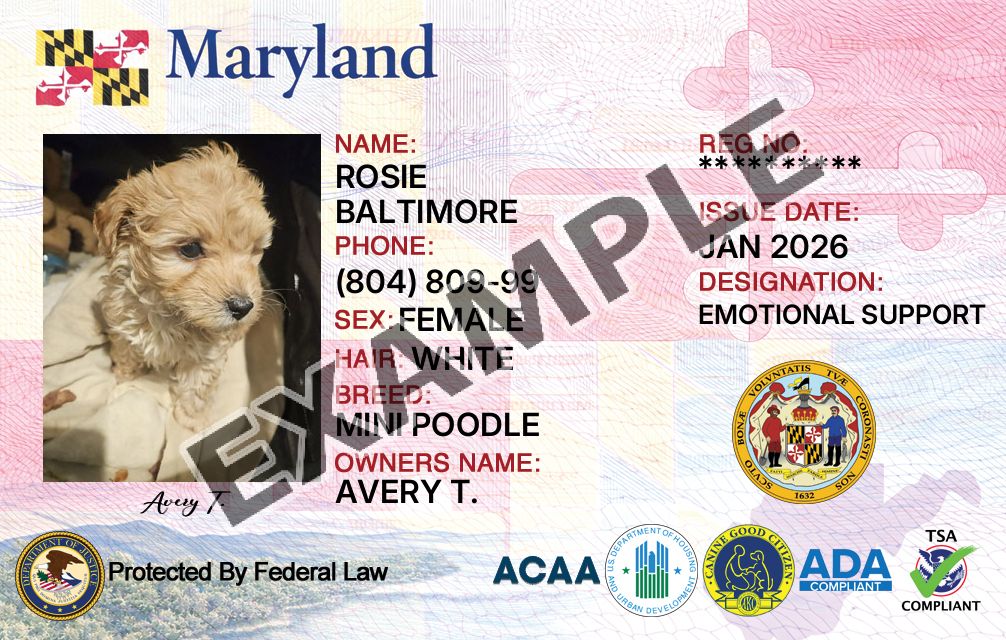
If you’re asking where do I register my dog in Baltimore, Maryland for my service dog or emotional support dog, the key point is this: your dog’s legal “registration” is usually a local pet license, while service dog and emotional support animal (ESA) status come from different laws and rules than licensing.
This page explains how to get a dog license in Baltimore, Maryland, which official offices handle animal control and rabies enforcement, what you’ll need, and how licensing differs from service dog rights and ESA housing accommodations. You’ll also see where to start if you’re looking for an animal control dog license Baltimore contact.
Where to Register or License Your Dog in Baltimore, Maryland
For most residents, “registering” a dog means obtaining (and renewing) a local pet license. In Baltimore, licensing and animal control functions are handled at the city level, and service requests for non-emergency animal issues commonly route through the City’s 311 system. The offices below are official or official-facing starting points used for licensing questions, animal control, and rabies-related enforcement within Baltimore City.
Baltimore City Animal Services (Non‑Emergency Requests via 311)
Use this for city service requests and non-emergency animal concerns (including many animal control matters). If you’re not sure where to register a dog in Baltimore, Maryland, 311 is a common official starting point to confirm the correct licensing process for your address.
Baltimore City Health Department — Animal Control Program (Facility Location)
This location is associated with Baltimore City’s animal control program. Call first to confirm where licensing is processed and what documents are required before you go in person.
Baltimore Animal Rescue and Care Shelter (BARCS) — City Animal Shelter
BARCS is Baltimore City’s animal shelter partner and a common point of contact for animal-related guidance. If your question is specifically about an animal control dog license Baltimore process, BARCS can often help direct you to the correct city channel for licensing and compliance steps.
Baltimore City Health Department (Main Department Headquarters)
This is the main Baltimore City Health Department location. If you’re trying to reach animal services leadership or need to confirm which unit handles a specific licensing or rabies enforcement question, start with 311 or the animal control program number above, then escalate if needed.
Overview of Dog Licensing in Baltimore, Maryland
What “dog registration” usually means
When people search for where to register a dog in Baltimore, Maryland, they are usually looking for the local pet licensing program. A license is a local government-issued authorization that ties a dog to an owner and helps fund animal control and shelter services. In Baltimore City, licensing is a legal requirement for dogs (and cats) over a certain age, and it is commonly tied to proof of current rabies vaccination.
Rabies vaccination and licensing are connected
Maryland rabies regulations provide that local animal control authorities generally may not license or register a dog without verifying rabies vaccination status documented by a current rabies vaccination certificate (unless an authorized delay applies). Practically, that means you should expect to show rabies documentation when applying for or renewing your Baltimore City pet license.
How Dog Licensing Works Locally in Baltimore, Maryland
Step 1: Confirm whether you are in Baltimore City (not Baltimore County)
Licensing is handled locally, and the correct office depends on where you actually live. “Baltimore, MD” mailing addresses can sometimes overlap with nearby jurisdictions, so start by confirming whether your home is within Baltimore City limits versus Baltimore County. If you are in Baltimore City, the City’s animal services channels (including 311 for non-emergency concerns) are typically the right starting point.
Step 2: Get your rabies vaccine up to date
Most licensing processes require proof that your dog’s rabies vaccination is current. Your veterinarian typically provides a rabies vaccination certificate and a rabies tag. Keep a copy (digital and paper) because you may need it for:
- first-time licensing
- renewals
- dog park registrations that require city licensing and rabies records
- resolution of bite reports or quarantine requirements
Step 3: Apply for or renew the license through the official local process
Baltimore City residents should follow the City’s official licensing process (and any designated partner channels used by the City for license issuance). The exact “how to pay / where to submit” steps can change, so use official contact points (like 311 or the animal control program number) to confirm:
- current fees and renewal cycles
- accepted proof of rabies vaccination (certificate vs. veterinarian record)
- whether in-person processing is available for the public
- how to replace a lost tag
Step 4: Keep your tag and documents accessible
Once issued, keep your city license tag on your dog’s collar/harness. Maintain a folder with rabies documentation and license details in case you need them for housing, travel, emergency boarding, or animal control inquiries.
Service Dog Laws in Baltimore, Maryland
A dog license is not the same thing as a service dog
A dog license in Baltimore, Maryland is a local public health/animal control requirement. A service dog is defined under federal disability law (ADA) as a dog individually trained to do work or perform tasks for a person with a disability. The fact that a dog is a service dog does not automatically replace local licensing obligations. In other words: you may still need the same local license and rabies documentation as any other dog.
Public access: what businesses and staff may ask
In public places covered by the ADA, staff generally may ask only two questions when it’s not obvious what the dog does:
- Is the dog a service animal required because of a disability?
- What work or task has the dog been trained to perform?
Staff generally cannot require you to show “service dog registration,” demand documentation, or ask for details about your disability as a condition of entry. Also, emotional support alone is not a “task” under the ADA service animal definition.
Behavior and control still matter
Service dogs must be under control, housebroken, and not pose a direct threat. Even a legitimate service dog can be asked to leave if it is out of control and the handler does not take effective action, or if it is not housebroken. Removal of the dog should not mean denial of service to the person—staff should offer the person a way to receive goods or services without the animal present.
Emotional Support Animal Rules in Baltimore, Maryland
An ESA is not a “registered” public-access animal
An emotional support animal (ESA) is not a service animal under the ADA for public access to stores, restaurants, and most public-facing businesses. That means an ESA generally does not have the same “go anywhere” rights as a trained service dog. So if you are searching where do I register my dog in Baltimore, Maryland for my service dog or emotional support dog, note that: there usually is no official ESA “registration” for public entry.
ESAs are most often relevant for housing (reasonable accommodations)
ESAs are most commonly handled under fair housing rules as a request for a reasonable accommodation to a housing provider’s pet policy. Under federal housing guidance, “assistance animals” can include animals that provide emotional support that alleviates one or more identified effects of a person’s disability. Housing providers may evaluate requests and can ask for reliable documentation when the disability and disability-related need for the animal are not obvious.
What documentation is typically involved
Many housing providers will request documentation from a licensed health care professional confirming (1) the person has a disability as defined by fair housing rules and (2) the animal provides disability-related assistance or emotional support. This is different from a city dog license: the license is about animal control and rabies compliance, while the ESA accommodation is about housing rights.